


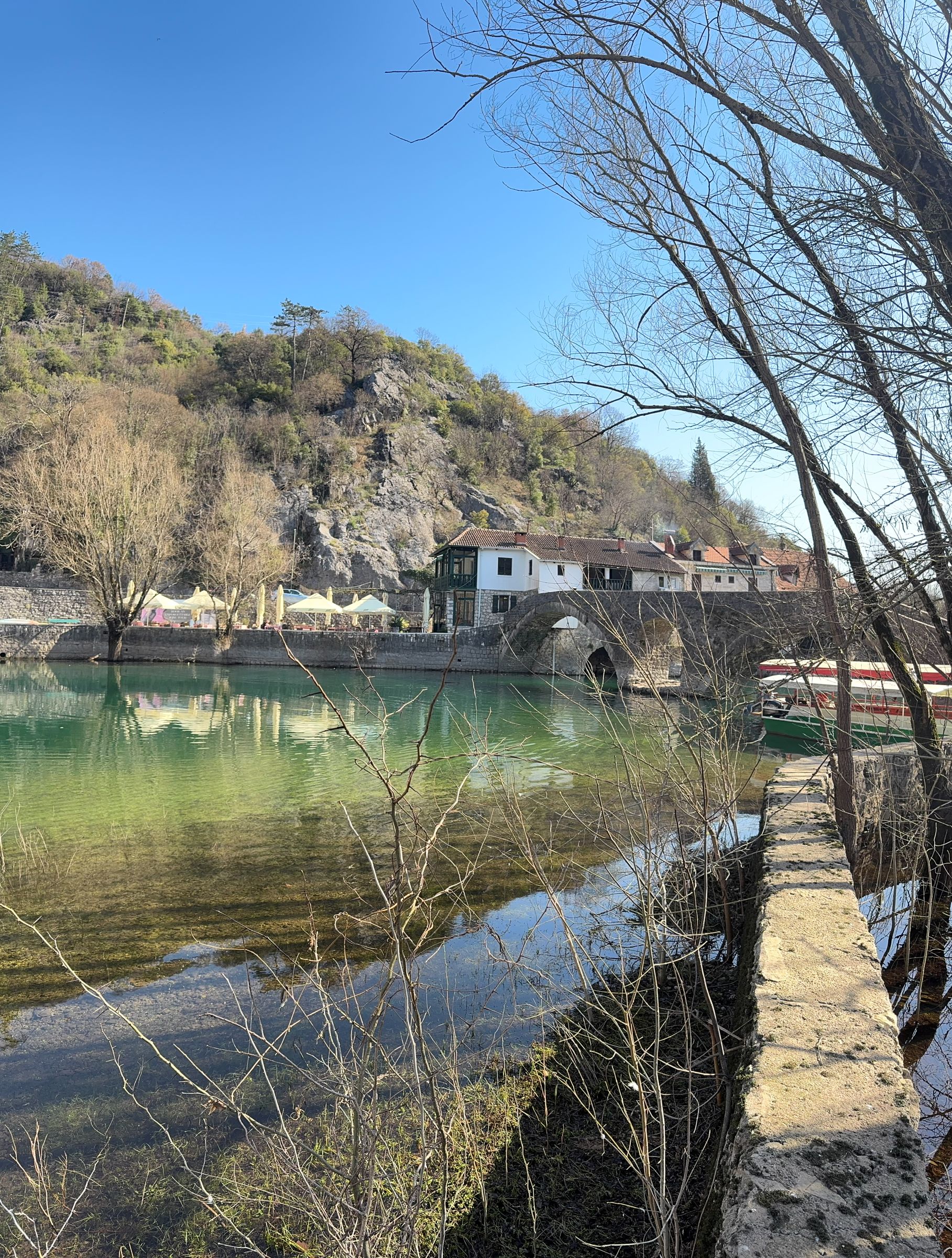
Rijeka Crnojevića is not a place that overwhelms you with landmarks at first glance. There are no grand squares or monumental buildings demanding attention. Here, architecture reveals itself slowly – through details, through stone, through what remains between the lines of history.
If you pause long enough, you begin to realize that almost every wall carries a story. Not one that is clearly written, but one you have to piece together yourself.
A Bridge That Is More Than a Crossing
The most recognizable symbol of the place is the bridge everyone photographs today – built in the 19th century during the rule of Knjaz Danilo Petrović. At first glance, it is a simple stone structure. But its value lies not in its size, but in its continuity.
It once connected trade routes, people, goods, and stories. And more than that – it led to a place that was once one of the most important trading centers in Montenegro.
Rijeka Crnojevića was, for a time, the main market – a place where goods were brought, exchanged, and then sent further toward the coast and inland. That spirit can still be felt today in the layout of the houses along the river, in the open spaces that hint at former gatherings of merchants, and in the logic of a place shaped by water and movement.
Fortresses That Chose Position Over Spectacle
Nearby, but often outside the focus of tourists, are the remains of fortifications that reveal how space was once understood. Žabljak Crnojevića was not built to impress visually, but to control the terrain.
Positioned to oversee access to Skadarsko jezero and key trade routes, it served as a strategic point rather than a symbol of power in the modern sense. Today, it stands in ruins, yet still clearly expresses the logic of the landscape – where defense happened, where observation mattered, where time was watched.
Hidden Layers – Traces of the Printing House and Everyday Life
One of the most important, yet least visible layers of this place is connected to Obod, located uphill as you cross Danilo’s Bridge. Even today, modest remains can be found where the Obodska štamparija once came to life.
There are no large signs or spectacular reconstructions. And yet, that subtlety adds weight – because you know you are standing where the first printed books of this region were created.
Between the bridge, the riverbank, and these almost hidden spots lies the true structure of former life. Old stone houses, remains of small docks, narrow paths that once connected the village to the water – together, they tell more than any guidebook ever could.
The Quiet Value of the Place
Rijeka Crnojevića does not try to impress. Its architecture does not dominate nature – it follows it. The bridge aligns with the river, houses follow the terrain, and fortifications follow the logic of defense.
But perhaps the most interesting part is that this place was once a center of movement – a market, a meeting point, a space of exchange. Today, it is calm, almost asleep for most of the year, yet the structure of that life is still present, just in a quieter form.
And perhaps that is its greatest value. Not in what was built long ago, but in the way time has left its trace.
